Score
The whole plan,
in one number.
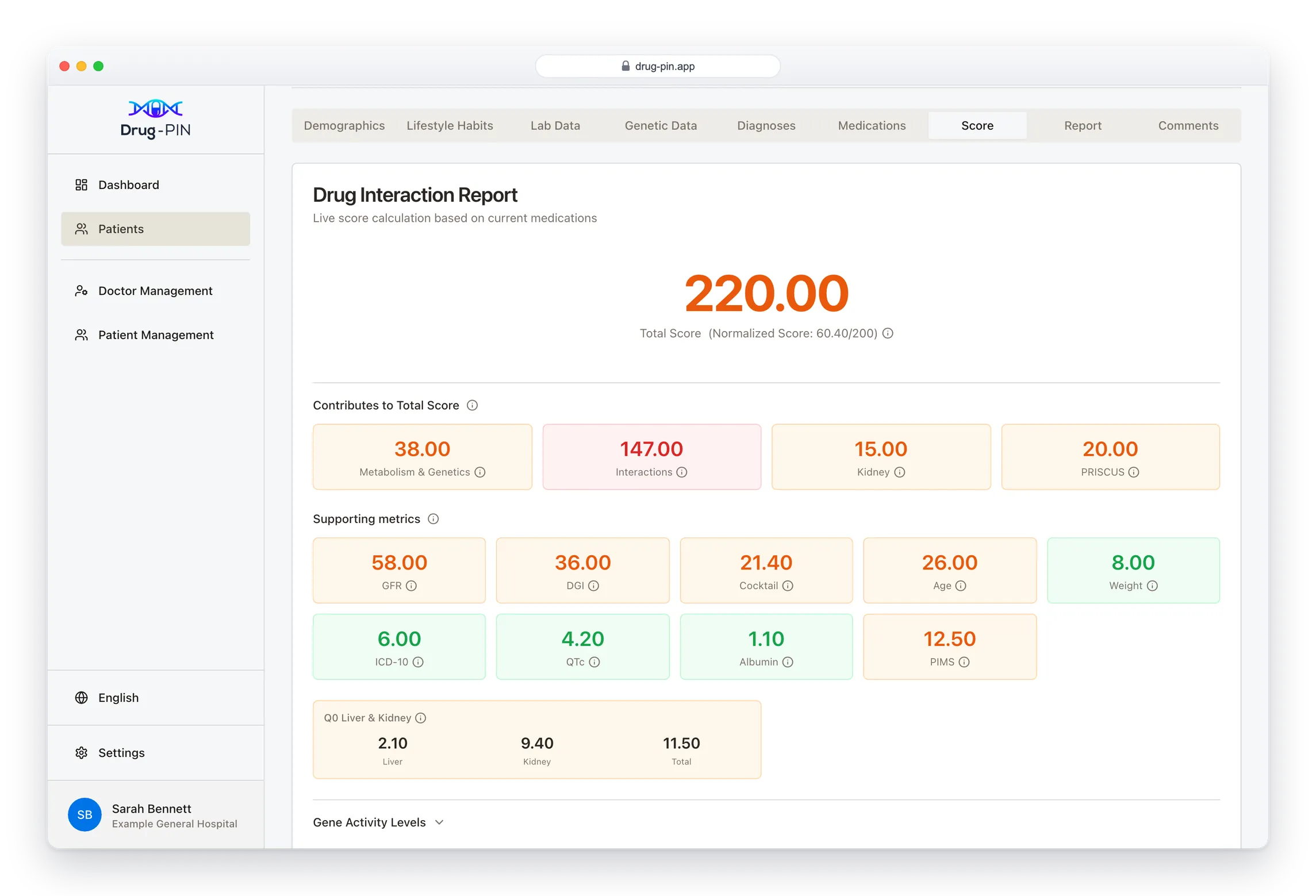
Drug-PIN scores a patient’s complete medication plan against their laboratory values, genotype, diagnoses and age. Drug against drug is only part of it. The total is the plain sum of four sub-scores, and the conflicts that produced each one are listed underneath it. A normalised figure sits beside the total, for comparing one patient with another or with themselves over time.
220
60 / 200
Illustrative figures, for a plan of 11 medications. The total here is 147 + 38 + 20 + 15, and has no fixed upper bound. The normalised score rescales it against patients on the same number of medications, onto a 1–200 scale.
What contributes
Four sub-scores add up to the total.
Nothing else is added. Everything else Drug-PIN shows is context for these four.
Interactions
A severity-weighted sum of the drug–drug interactions in the plan. One severe interaction contributes more than several mild ones, so a count alone would mislead.
Metabolism & genetics
The metabolic load of the whole plan across CYP enzymes and transporters, together with mismatches between the patient’s pharmacogenomic variants and the drugs they are taking.
PRISCUS
Potentially inappropriate medication in older patients, from the German PRISCUS list, which applies from age 65.
The European EU(7)-PIM list is evaluated and shown alongside it, but is not added to the total.
Kidney
Derived from eGFR and weighted by the patient’s stage of renal impairment, plus drugs that are specifically inadvisable at that level of kidney function.
Supporting metrics
Shown for context. They stay outside the total.
These feed the four sub-scores above. They are displayed on their own so you can see what drove a number. Adding them yourself would double-count.
QTc
Drug-induced QT prolongation, against age- and sex-specific thresholds.
Albumin
Free-drug levels in hypoalbuminaemia, by protein-binding profile.
Age
Paediatric or geriatric cautions triggered by this patient’s age.
Weight
Weight- and BMI-based cautions where a weight-dependent drug is in the plan.
ICD-10
Drug–disease conflicts, such as an NSAID with active GI bleeding.
Enzyme load
How strongly the plan as a whole loads each CYP enzyme and transporter.
eGFR
Drugs flagged at this filtration rate.
Q₀ liver & kidney
Accumulation risk from impaired hepatic or renal clearance.
The conflicts
Every point traces back to something you can read.
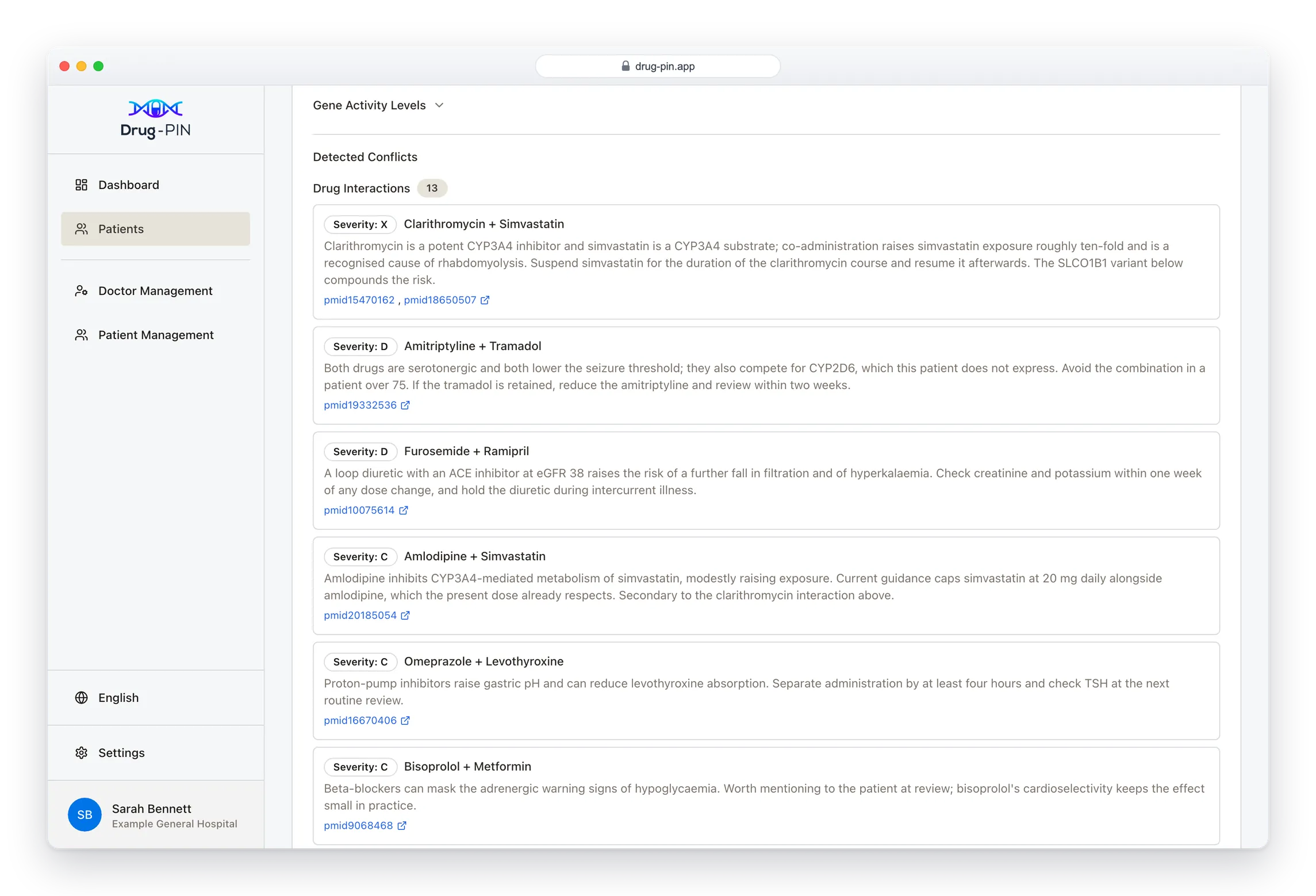
The total is not a verdict handed down. Underneath it is the list it was built from: each interacting pair, how severe it is, the mechanism in a sentence, and the published evidence behind it. A score can be checked.
Changing the plan
Alternatives are candidates for you to weigh.
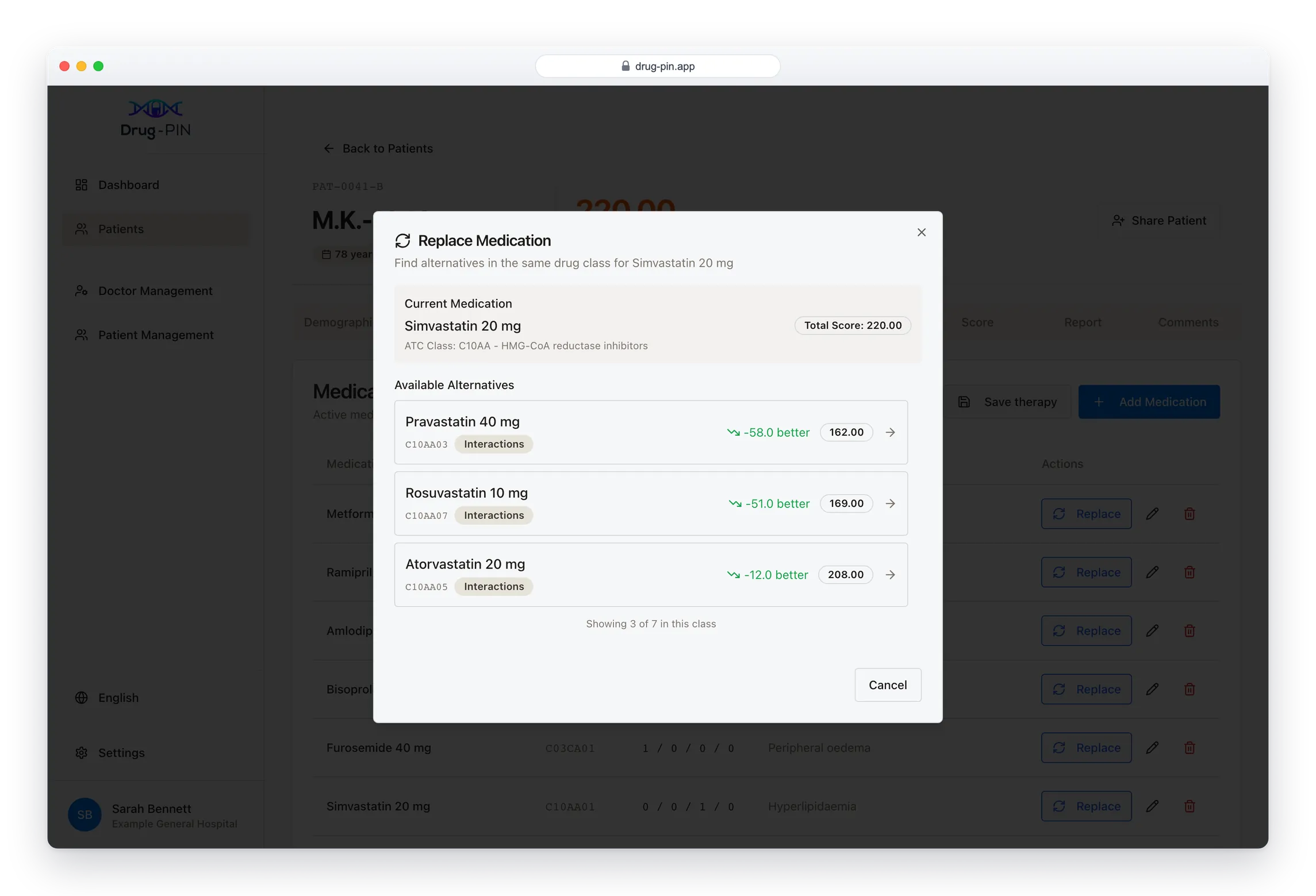
The score is only useful if you can act on it. For any drug in the plan, Drug-PIN shows a list of alternatives for the therapy, rescores the patient’s entire regimen with each substitution made, and reports the difference.
Rescored for this patient
The whole plan is recalculated, including every drug you left alone, so the figure shown is that patient’s, against their own genotype, kidney function and diagnoses.
What the difference means
A better projected score means Drug-PIN found fewer measurable conflicts. It does not mean the drug is better for this patient, and it does not account for what the record does not contain.
Comparable substances
The list covers therapeutically comparable substances for which Drug-PIN holds interaction data, so the comparison is like for like.
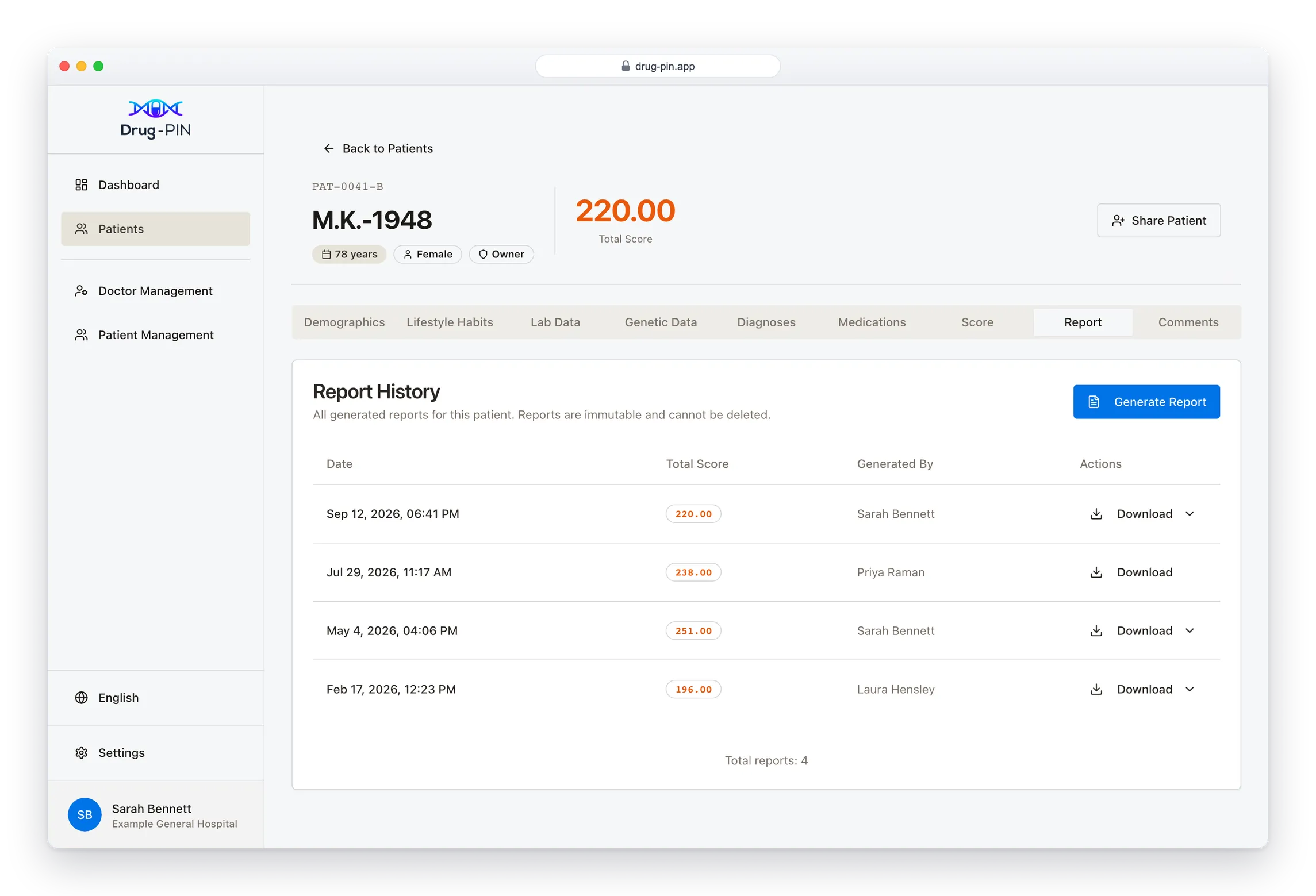
The report
What the doctor keeps.
A final, locked PDF for the patient record, previewed in full before it is issued, then frozen, so later changes to data or templates cannot alter a document that has already been signed.
- Patient data, laboratory values and clinical ratings
- Predicted biochemical-functional phenotype
- The medication list with the total score
- Drug-class comparison for every medication
Issued as a short summary or the full document. The full version adds the score composition, the interaction list by severity, the kidney and PRISCUS recommendations, the metabolic analysis and the biochemical interaction matrix.
Try it on a case you already know.
The quickest way to judge a score is to run a case where you already know the answer.
Request trial access